From the Operating Theatre to the Gallows: What Dr Eduard Krebsbach Teaches Me About the Hippocratic Oath
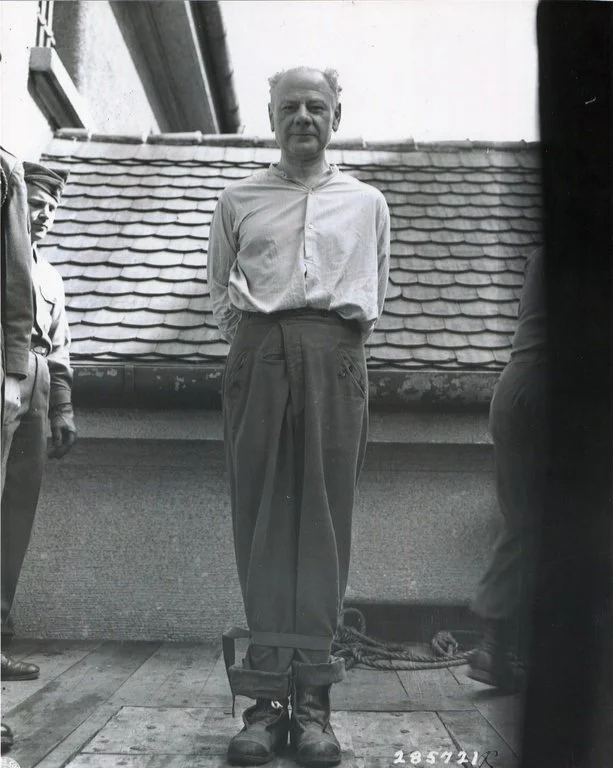
Eduard Krebsbach at his execution in 1946
Courtesy of the United states Holocaust Memorial museum
What Dr Eduard Krebsbach Teaches Me About the
As a British ENT surgeon trained in the NHS and at respected medical institutions, I still reflect on the principles of the Hippocratic Oath before every challenging case.
“Primum non nocere—First, do no harm.”
“I will use treatment to help the sick according to my ability and judgement, but never with a view to injury and wrong-doing.”
These tenets were instilled throughout medical school, foundation training, core surgical training, and higher specialty training—the same rigorous foundation that every doctor in our profession shares. That is exactly why the story of Dr Eduard Krebsbach continues to haunt me. Krebsbach was a practising paediatrician before the war. A doctor who, like me, had sworn an oath to preserve life. Yet between 1941 and 1943, as SS Standortarzt (chief camp physician) at Mauthausen concentration camp and its Gusen subcamp, he became infamous among prisoners as “Dr Spritzbach” (Dr Injection). He systematised the murder of hundreds, possibly thousands, of sick, disabled, or “unproductive” inmates through direct intracardiac injections of phenol or petrol.
The Oath We All Swore
Medical training is remarkably consistent across time and borders. We study anatomy, pharmacology, ethics, and the grave responsibility of holding another human being’s life in our hands. We are taught to see every patient as an individual worthy of dignity, regardless of their circumstances. Krebsbach would have undergone equivalent training in an era when German and Austrian medicine was at the forefront of many fields. Yet that moral framework crumbled under the Nazi regime, which redefined “healing” as a duty owed only to the Volk, while elimination of the “unworthy” was reframed as legitimate medical practice.
Chilling Words from the Trial
The 1946 Mauthausen Trial laid bare how thoroughly he had abandoned his oath. Here is part of the exchange with the prosecutor:
Krebsbach: When I started work, I was ordered by the head of Office III D to kill or have killed all those who were unable to work, and the incurably sick.
Prosecutor: And how did you carry out this order?
Krebsbach: Incurably sick inmates who were incapable of work were generally gassed. Some were also killed by gasoline injection.
Prosecutor: To your knowledge, how many persons were killed in this way in your presence?
Krebsbach: (no answer)
Prosecutor: You were ordered to kill those unfit to live?
Krebsbach: Yes. I was ordered to have persons killed if I was of the opinion that they were a burden on the state.
When later asked whether it had ever occurred to him that these were human beings, he replied: “No. People are like animals. Animals that are born deformed or incapable of living are put down at birth. This should be done for humanitarian reasons with people as well. This would prevent a lot of misery and unhappiness.”
These are the recorded words of a physician whose training mirrored the foundations of my own.
How Systems and Groupthink Corrupt Good Training
I have seen how hierarchical medical culture can subtly erode individual judgement. Senior consultants’ opinions carry significant weight; national guidance and local protocols can, in practice, function almost as de facto protocols. In extreme settings—wartime, ideological pressure, or institutional imperatives—the drive to conform becomes overwhelming.
Krebsbach did not act in isolation. The Nazi establishment supplied the intellectual scaffolding: eugenics theories once discussed in respectable journals became state policy; bureaucratic euphemisms (“special treatment”, “14f13”) sanitised horror; and peer approval rewarded compliance. The descent was gradual—propaganda, career incentives, groupthink, and the systematic dehumanisation of “the other” made the unthinkable routine.
A paediatrician trained to comfort sick children began selecting emaciated prisoners for lethal injection.
Modern Debates on Euthanasia
Today, in Britain and elsewhere, there are intense, legitimate discussions around assisted dying and euthanasia, framed within strict legal and ethical safeguards. These debates rightly emphasise compassion, patient autonomy, and safeguards against abuse. Yet Krebsbach’s case stands as a stark historical warning: once a medicalised “solution” to human suffering is normalised by the state and the profession, and once certain lives are categorised as burdens, the slope can prove steeper and more slippery than we imagine. The same groupthink mechanisms—guidance becoming dogma, professional consensus overriding conscience—are not confined to the 1940s.
Why This Matters
As a writer of historical fiction, I explore these grey zones precisely because they are so human. What internal rationalisations did Krebsbach repeat to himself at night? How did the syringe shift in his hand from an instrument of healing to one of death? I do not write to sensationalise evil, but as a cautionary mirror. The Hippocratic Oath is not self-enforcing. It demands constant vigilance, moral courage, and the willingness to question authority—or prevailing consensus—when it conflicts with our fundamental duty either to our individual patients or to the collective welfare of people.
Perceived ‘worth’ is not a concept that ever enters my head when I treat patients. I don’t think of the Hippocratic Oath as I treat my patients, as I hope the principles are sufficiently engrained in me. History shows how quickly a mindset can change when the state, the institution, or professional culture redefines who counts as fully human.
Dr Eduard Krebsbach was hanged at Landsberg Prison on 28 May 1947 following his conviction. Justice was served. Yet the deeper lesson endures: physicians with training essentially identical in spirit to mine proved terrifyingly susceptible to the normalisation of atrocity.
Every time I sit down to write, I feel the weight of that shared profession. It compels me to ask: Under what pressures would I hold the line? What small compromises might I justify?
The scalpel and the syringe can both save and destroy life. The difference lies never in the tool, but always in the moral framework of the collective and its influence on the hand that holds it.
The Cruel Dance: Dancing Bears, Trauma, and the Shadows in Dancer on the Edge of War
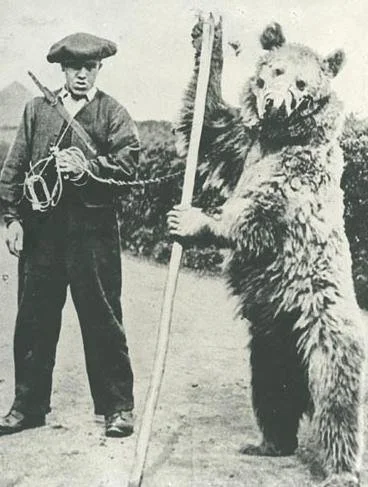
Dancing bear in Arundel, England
There is something deeply haunting about the image of a dancing bear.
For centuries in Eastern Europe, bears — often captured as cubs — were trained through pain and fear to “dance” for human entertainment. A ring through the nose, a chain, and the sound of a drum or zurna would force the animal onto its hind legs, swaying and turning in grotesque imitation of human movement. What audiences saw as entertainment was, for the bear, a daily performance of suffering.
This image stayed with me long before I began writing Dancer on the Edge of War.
In the novel, the recurring motif of the dancing bear is not decorative. It is central to the protagonist Jan Podolski’s fractured mind. The sound of the zurna — that piercing, reedy wail — becomes the trigger that pulls him back into trauma. In his hallucinations, Jan himself becomes the chained bear, forced to dance while Monte Cassino burns around him. The bear is both victim and mirror — a creature stripped of dignity, performing pain for an indifferent world.
The Real History
The tradition of dancing bears was particularly strong in parts of Poland, Romania, and Bulgaria. Bear cubs were taken from their mothers, often killed in the process, and then “trained” with hot irons, nails driven into their paws, and constant beating. The goal was simple: make the bear associate the music with pain, so that when the music played, the bear would stand and move in an attempt to make the pain stop.
It was, in every sense, a dance of survival.
By contrast, Wojtek the Bear — the real Syrian brown bear who became a soldier in the Polish 2nd Corps — represents something almost miraculous. Instead of being chained and forced to perform, he was given a rank, a name, and a purpose. He carried shells at Monte Cassino not out of fear, but as part of a community that accepted him.
Wojtek became a symbol of freedom and dignity. The dancing bears, by contrast, remain symbols of exploitation and brokenness.
Why This Matters in the Novel
For Jan, the dancing bear is more than a historical image. It is the embodiment of his own psychological imprisonment. He survived the gulags. He survived Monte Cassino. But he cannot escape the feeling that he is still performing — still chained, still forced to move to a rhythm he did not choose.
The boy who later enters his life becomes another kind of mirror. And through their complicated relationship, Jan is forced to confront what it means to break the chain — or whether some wounds simply make us dance forever.
You can find out more about Wojtek in Dancer on the Edge of War here.
The Unfairness of Fairness
The Unfairness of Fairness on Holocaust Remembrance
In this blog on the inclusivity of Holocaust Education, I argue that the modern-day tendency towards inclusivity has contributed to the Jewish nation becoming the forgotten victim of the Holocaust.
Schoolboy discussions
When I was a schoolboy, I had many discussions about the Second World War. A boys-only, predominantly Church of England school, there were just a handful of Jewish pupils and my school experience was very much culturally Christian. I lost count of the times when we discussed the evils of the Holocaust that I was “informed” that it wasn’t just the Jews who were murdered in concentration camps. There were just as many who died by an aggregation of other groups. The logic was simple: 6 million versus 6 million.
Who Knows What
In a recent survey of young American adults (18-39), almost 1 in 5 said they believed the holocaust was a myth, had been exaggerated or they weren’t very sure what happened. Almost 2/3 did not know that 6 million Jews were killed in the Holocaust and one in 10 believed that Jews caused the Holocaust.
This extraordinary level of ignorance of the darkest period in human history is a true indictment of the American education system, and the organisers of the teaching curricula should hang their heads in shame. Many feel that the education of the Holocaust has been so sanitised and watered down that people have become numbed to the atrocities and see them as an aberrance in human history.
A Sordid Educational Approach
I was recently asked by a publisher to be a beta reader for a book that was written from the viewpoint of a character who was an historical Nazi doctor. I was told that it was written (by a non-Jew) as an antidote to the “sanitisation” of Holocaust history. What I read was so gruesome and ghoulish, that while there was clearly more than an element of truth in the writing, that I could not see it in any way helping the cause of Holocaust education. Instead, I felt it would appeal to the vilest elements of society that would appreciate it, not for its educational message, but in celebration for its unspeakable depravity.
The Prime Motivation for the Holocaust
While the numerical arguments of the victim groups selected for death are valid, there is no doubt that the Holocaust was about the Jews. As discussed in my previous blog, Jews were murdered in massive numbers by Einsatzgruppen, well before the concentration camps were even built and not in any way exclusively by the German nation. The principle aim of the Einsatzgruppen was the Final Solution to the Jewish Question (German: Endlösung der Judenfrage.
The Truth – but not the Whole Truth and Nothing but the Truth
In 2008, the former leader of the Labour Party, Jeremy Corbyn made reference to the “millions murdered” in his Holocaust Memorial statement. The notable absence of who the victims and the perpetrators were did not go unnoticed. In 2017, the statement from President Trump on Holocaust Memorial Day cited “the victims, survivors, (and) heroes of the Holocaust…” without mention of Jews or antisemitism.
Genocide has taken many forms throughout humanity’s history. The treatment of Uyghur Muslims in present day China represents a stain on the Chinese administration. There are numerous examples of discrimination and persecution in modern times that could and should be identified. The unique case with the Holocaust, is that the plan was not the mere persecution or subjugation of Jews, but the intent on their complete annihilation.
“It is entirely unfair to the Jewish nation that they should feel that their ancestors died as Jews and remembered as people“
The website of the Holocaust Memorial Day Trust mentions the term identity-based hostility, but nowhere does it mention “Jews” or “anti-Semitism.” If the website was dedicated to genocide, then I would entirely understand that the Jewish nation couldn’t possibly claim exclusive rights, and neither do they. The history of the Holocaust is, however, integrally related to the Jews. I absolutely would welcome a Memorial Day for Genocide, but that would need to be with a separate organisation, on a separate event and on a separate occasion.
What We Don’t Talk About
Several historians blame the style of Holocaust education on the failures to educate people. Without a doubt, the subject is a difficult one to discuss and even among the Jewish community, only a section is willing to talk about it. They blame the sanitisation of Holocaust storytelling and the biased way that facts are lifted to portray a palatable narrative. That is understandable. The loss of our ancestors to the unprecedented levels of brutality of Nazi Germany is not a popular subject across the dinner table.
One criticism levelled against the British approach to Holocaust education is that all too often, the exclusion from Britain of most refugees from Europe in the 1930s is overlooked, and the emphasis focuses on the relatively small numbers of children in the Kindertransport – certainly not on the tens of thousands of adults who were turned away – not the thousands or millions who might have sought refuge in the British Mandate of Palestine in the 1930s when Britain, as the mandatory power, kept the doors shut, and continued to block Jews from entering Palestine – even after the war – even after the discovery of the concentration camps. The UK put Jewish refugees in displaced persons camps in Cyprus and Germany.
The Unfairness of Fairness
While we are all keen to be inclusive in the way we approach justice and fairness, we should be always mindful for when the goals of inclusivity do not undermine the message. It is entirely unfair to the Jewish nation that they should feel that their ancestors died as Jews and remembered as people. We must not allow our modern approach to Holocaust teaching betray the very people it is designed to protect.
There has been much recent discussion regarding the history of Britain and its complicity and normalisation of slavery of black people. It seems incomprehensible how this could have happened and even more so, that it went on for more than 2 centuries. It is absolutely vital that the education about our dark past should never cease.
I was recently discussing the history of slavery with a West Indian friend of mine. He said there are elements in our society who argue in knee jerk whataboutery that the people of other nations were also subject to slavery so that black Africans can’t claim exclusivity on it. He feels this inadvertently takes away the acknowledgement of the history of enslavement from his ancestral past. So how did I feel when my peers at school argued that the Holocaust wasn’t just about the Jews? I have more than an inkling at how the descendants of black slavery feel when they hear its equivalent.
If you found this post interesting, please like this on Facebook and sign up to my newsletter to receive more updates on my books and blogs. Adam Frosh is the author of the science fiction/ history novel, Space Taxis.
Yarzheit candle
A Patient with a Number.
I was 26 years old when I was a junior doctor working in the Bart’s and Homerton Hospital Accident and Emergency Unit. The two units tended to have very different clientele presenting with a very different set of symptoms.
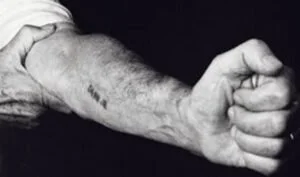
Tattoo on an Auschwitz prisoner
I was 26 years old when I was a junior doctor working in the Bart’s and Homerton Hospital Accident and Emergency Unit. The two units tended to have very different clientele presenting with a very different set of symptoms.
The patient
One morning shift at Homerton was particularly memorable for me. A man was ambulanced in unconscious. There was not much information on him available. While the exact circumstances of how he was found is lost to memory, he was an elderly man who was fairly thin and still wearing his pyjamas. One thing I did notice when I was inserting a venous catheter was a number that had been tattooed roughly on his forearm. The ink was a greenish blue.
A quick check of his sugar levels indicated that he was almost certainly an insulin dependent diabetic in a hypoglycemic coma. I gave him a slug of intravenous glucose and, like magic, the man woke up.
“Thank you,” he said. “You got the diagnosis right.”
He had an Eastern European accent and his warm personality shone through. My next thought was how interesting it was that a comatose, anonymous body could, in a moment, become alive and animated. His next comments shocked me.
“I know it comes as a wonder to doctors how a lifeless body can turn into an actual person with just one shot of sugar.”
Had he read my mind? Was it something that other doctors had said to him from his previous hypos? With my black curly hair and name, my Jewish ancestry was obvious to him. I looked again at the number on his arm.
“Do you know what that is?” he said smiling at me.
I looked back in horror at him and simply gave him a brief nod.
We looked after him in the department until he felt well enough to leave. I shook his hand but said nothing further to him.
Reflection
The man haunts me to this day. At the time I felt it somehow wasn’t right to discuss his experience in a concentration camp. I was shocked into a naive silence. What do you say in this circumstance? Did he want to relive the experience for the sake of my curiosity? Was that the right decision or even my decision to make? In my silence, I denied myself and others around me a snippet of his first hand experience.
We each regret rejecting the many opportunities that presented themselves to us in our youth. What is important now is that we never dismiss learning the lessons from the past. I remember the man’s warm smile very well. I can sense it even now as I write this.
If you found this post interesting, please like this on Facebook and sign up to my newsletter to receive more updates on my books and blogs. Adam Frosh is the author of the science fiction/ history novel, Space Taxis.
What is the Secret the Lithuanian Government Doesn’t Want You to Know About?
A slaughter pit in the Ponary Forest. Ponar Massacre

Death pit in the Ponary Forest, Lithuania
What is the Secret the Lithuanian Government Doesn’t Want You to Know About?
The time was The Second World War, the setting Nazi occupied Europe.
The question to be answered is: Why was the treatment of Jews during the early period of the German occupations worse in Eastern than Western European countries?
Almost 95% of pre-war Lithuania’s 220,000 Jews perished in World War II. Moreover, they were almost all murdered within a 6 month period from the Summer of 1941.
Horrifyingly, in June, 1941, a large proportion of the Lithuanian people welcomed the German invasion. For many, they saw the Germans as great liberators, saving them from the strict collectivist rule of Soviet occupation.
The fate of Lithuania’s Jews during the early period of Nazi occupation is a tragedy beyond comprehension.
The cruel treatment of Jews by the hands of the German occupiers is undisputed. Where the water is more murky, however, is when we study the treatment of Jews by the indigenous Lithuanians of the time.
In all occupied countries, the German administration coerced the people to help round up Jews. Failure to cooperate would risk execution and the deaths of their relatives. The Jews of Lithuania, Latvia, Belarus and Ukraine were slaughtered at an early stage.
In contrast, the collaboration in the systematic degradation, torture and murder of Jews by the non-Jewish people of France and Scandinavia was much less significant.
Why this difference?
The Slaughter on an Industrial Scale Started Even Before the Death Camps
Most of the death camps, including Auschwitz Birkenau, were not active until 1942. Therefore, at the beginning of the war, the deportation of Jews for mass slaughter was not yet an option. The preferred methods of slaughter at the early stages of the war was delivered by the Einsatzgruppen. They were essentially a group of death squads that included the Waffen SS, Order Police, Wehrmacht, local nationalist forces and collaborators. The latter (ie local people) helped to identify and find victims as well as kill them.
Just one example of the group’s work happened over a two day period in September 1941. A small detachment of Einsatzgruppe C along with larger units of Waffen SS, Order Police and Ukrainian auxiliaries shot 33,771 Jews in Babi Yar, Kiev. It is well recorded that many of the killers and victims knew one another as neighbours and colleagues.