From the Operating Theatre to the Gallows: What Dr Eduard Krebsbach Teaches Me About the Hippocratic Oath
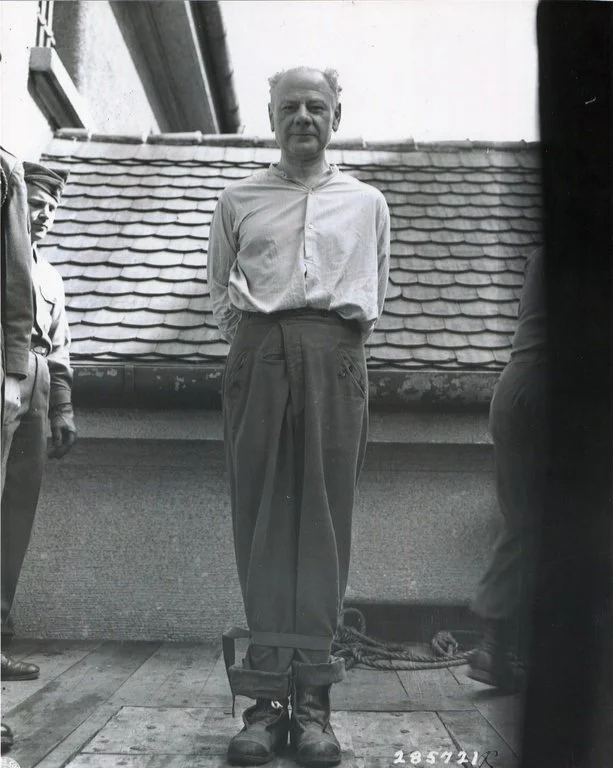
Eduard Krebsbach at his execution in 1946
Courtesy of the United states Holocaust Memorial museum
What Dr Eduard Krebsbach Teaches Me About the
As a British ENT surgeon trained in the NHS and at respected medical institutions, I still reflect on the principles of the Hippocratic Oath before every challenging case.
“Primum non nocere—First, do no harm.”
“I will use treatment to help the sick according to my ability and judgement, but never with a view to injury and wrong-doing.”
These tenets were instilled throughout medical school, foundation training, core surgical training, and higher specialty training—the same rigorous foundation that every doctor in our profession shares. That is exactly why the story of Dr Eduard Krebsbach continues to haunt me. Krebsbach was a practising paediatrician before the war. A doctor who, like me, had sworn an oath to preserve life. Yet between 1941 and 1943, as SS Standortarzt (chief camp physician) at Mauthausen concentration camp and its Gusen subcamp, he became infamous among prisoners as “Dr Spritzbach” (Dr Injection). He systematised the murder of hundreds, possibly thousands, of sick, disabled, or “unproductive” inmates through direct intracardiac injections of phenol or petrol.
The Oath We All Swore
Medical training is remarkably consistent across time and borders. We study anatomy, pharmacology, ethics, and the grave responsibility of holding another human being’s life in our hands. We are taught to see every patient as an individual worthy of dignity, regardless of their circumstances. Krebsbach would have undergone equivalent training in an era when German and Austrian medicine was at the forefront of many fields. Yet that moral framework crumbled under the Nazi regime, which redefined “healing” as a duty owed only to the Volk, while elimination of the “unworthy” was reframed as legitimate medical practice.
Chilling Words from the Trial
The 1946 Mauthausen Trial laid bare how thoroughly he had abandoned his oath. Here is part of the exchange with the prosecutor:
Krebsbach: When I started work, I was ordered by the head of Office III D to kill or have killed all those who were unable to work, and the incurably sick.
Prosecutor: And how did you carry out this order?
Krebsbach: Incurably sick inmates who were incapable of work were generally gassed. Some were also killed by gasoline injection.
Prosecutor: To your knowledge, how many persons were killed in this way in your presence?
Krebsbach: (no answer)
Prosecutor: You were ordered to kill those unfit to live?
Krebsbach: Yes. I was ordered to have persons killed if I was of the opinion that they were a burden on the state.
When later asked whether it had ever occurred to him that these were human beings, he replied: “No. People are like animals. Animals that are born deformed or incapable of living are put down at birth. This should be done for humanitarian reasons with people as well. This would prevent a lot of misery and unhappiness.”
These are the recorded words of a physician whose training mirrored the foundations of my own.
How Systems and Groupthink Corrupt Good Training
I have seen how hierarchical medical culture can subtly erode individual judgement. Senior consultants’ opinions carry significant weight; national guidance and local protocols can, in practice, function almost as de facto protocols. In extreme settings—wartime, ideological pressure, or institutional imperatives—the drive to conform becomes overwhelming.
Krebsbach did not act in isolation. The Nazi establishment supplied the intellectual scaffolding: eugenics theories once discussed in respectable journals became state policy; bureaucratic euphemisms (“special treatment”, “14f13”) sanitised horror; and peer approval rewarded compliance. The descent was gradual—propaganda, career incentives, groupthink, and the systematic dehumanisation of “the other” made the unthinkable routine.
A paediatrician trained to comfort sick children began selecting emaciated prisoners for lethal injection.
Modern Debates on Euthanasia
Today, in Britain and elsewhere, there are intense, legitimate discussions around assisted dying and euthanasia, framed within strict legal and ethical safeguards. These debates rightly emphasise compassion, patient autonomy, and safeguards against abuse. Yet Krebsbach’s case stands as a stark historical warning: once a medicalised “solution” to human suffering is normalised by the state and the profession, and once certain lives are categorised as burdens, the slope can prove steeper and more slippery than we imagine. The same groupthink mechanisms—guidance becoming dogma, professional consensus overriding conscience—are not confined to the 1940s.
Why This Matters
As a writer of historical fiction, I explore these grey zones precisely because they are so human. What internal rationalisations did Krebsbach repeat to himself at night? How did the syringe shift in his hand from an instrument of healing to one of death? I do not write to sensationalise evil, but as a cautionary mirror. The Hippocratic Oath is not self-enforcing. It demands constant vigilance, moral courage, and the willingness to question authority—or prevailing consensus—when it conflicts with our fundamental duty either to our individual patients or to the collective welfare of people.
Perceived ‘worth’ is not a concept that ever enters my head when I treat patients. I don’t think of the Hippocratic Oath as I treat my patients, as I hope the principles are sufficiently engrained in me. History shows how quickly a mindset can change when the state, the institution, or professional culture redefines who counts as fully human.
Dr Eduard Krebsbach was hanged at Landsberg Prison on 28 May 1947 following his conviction. Justice was served. Yet the deeper lesson endures: physicians with training essentially identical in spirit to mine proved terrifyingly susceptible to the normalisation of atrocity.
Every time I sit down to write, I feel the weight of that shared profession. It compels me to ask: Under what pressures would I hold the line? What small compromises might I justify?
The scalpel and the syringe can both save and destroy life. The difference lies never in the tool, but always in the moral framework of the collective and its influence on the hand that holds it.