The Cruel Dance: Dancing Bears, Trauma, and the Shadows in Dancer on the Edge of War
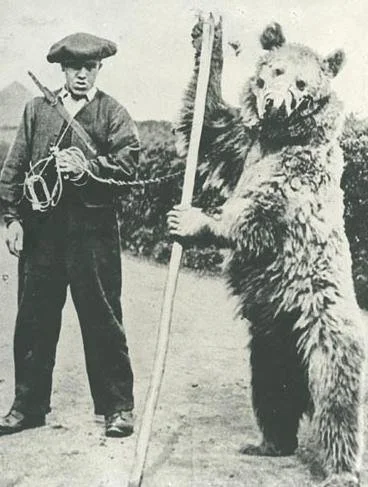
Dancing bear in Arundel, England
There is something deeply haunting about the image of a dancing bear.
For centuries in Eastern Europe, bears — often captured as cubs — were trained through pain and fear to “dance” for human entertainment. A ring through the nose, a chain, and the sound of a drum or zurna would force the animal onto its hind legs, swaying and turning in grotesque imitation of human movement. What audiences saw as entertainment was, for the bear, a daily performance of suffering.
This image stayed with me long before I began writing Dancer on the Edge of War.
In the novel, the recurring motif of the dancing bear is not decorative. It is central to the protagonist Jan Podolski’s fractured mind. The sound of the zurna — that piercing, reedy wail — becomes the trigger that pulls him back into trauma. In his hallucinations, Jan himself becomes the chained bear, forced to dance while Monte Cassino burns around him. The bear is both victim and mirror — a creature stripped of dignity, performing pain for an indifferent world.
The Real History
The tradition of dancing bears was particularly strong in parts of Poland, Romania, and Bulgaria. Bear cubs were taken from their mothers, often killed in the process, and then “trained” with hot irons, nails driven into their paws, and constant beating. The goal was simple: make the bear associate the music with pain, so that when the music played, the bear would stand and move in an attempt to make the pain stop.
It was, in every sense, a dance of survival.
By contrast, Wojtek the Bear — the real Syrian brown bear who became a soldier in the Polish 2nd Corps — represents something almost miraculous. Instead of being chained and forced to perform, he was given a rank, a name, and a purpose. He carried shells at Monte Cassino not out of fear, but as part of a community that accepted him.
Wojtek became a symbol of freedom and dignity. The dancing bears, by contrast, remain symbols of exploitation and brokenness.
Why This Matters in the Novel
For Jan, the dancing bear is more than a historical image. It is the embodiment of his own psychological imprisonment. He survived the gulags. He survived Monte Cassino. But he cannot escape the feeling that he is still performing — still chained, still forced to move to a rhythm he did not choose.
The boy who later enters his life becomes another kind of mirror. And through their complicated relationship, Jan is forced to confront what it means to break the chain — or whether some wounds simply make us dance forever.
You can find out more about Wojtek in Dancer on the Edge of War here.